
If you’re trying to understand how the matter smart home standard actually works—and whether it’s worth your attention—you’re in the right place. With so many smart devices, platforms, and compatibility claims on the market, it’s hard to know what truly connects seamlessly and what still requires workarounds.
This article breaks down what the matter smart home standard is, how it simplifies device integration, and what it means for your current and future smart home setup. We’ll focus on practical implications: compatibility across ecosystems, setup improvements, security considerations, and how it changes everyday automation.
Our insights are based on extensive research into smart home protocols, device interoperability testing, and ongoing analysis of connected living trends. By the end, you’ll have a clear, jargon-free understanding of how Matter impacts your devices—and whether now is the right time to adopt it.
The first time my smart lights refused to talk to my thermostat, I spent an hour toggling between apps (muttering like a frustrated extra in a sci‑fi movie). That chaos—different hubs, passwords, and “compatible” devices that weren’t—has defined modern connected living.
Now, a new universal framework, the matter smart home standard, promises one shared language for devices.
What this means for you:
- Fewer apps
- Faster setup
- Reliable cross-brand control
In this guide, you’ll learn how it works, what labels to look for, and how this new industry standard for smart home technology simplifies everything. For good. Finally.
What Is the New Connectivity Standard?
The new connectivity standard is called Matter, an open-source connectivity protocol (that means its underlying code is publicly available and not controlled by a single company). In simple terms, it’s a universal “seal of approval” that ensures smart devices can talk to each other seamlessly, regardless of brand. Think of it less like a product and more like a shared language for your home.
So, what’s in it for you? First and foremost, simplicity. With the matter smart home standard, you’re no longer locked into buying devices that only work with Apple HomeKit or only respond to Alexa. Instead, devices certified under Matter are designed for interoperability—meaning they work across platforms. It’s the smart home equivalent of finally getting everyone to agree on one group chat.
Moreover, it’s backed by major players like Apple, Google, and Amazon, which signals long-term support and industry-wide adoption. That collaboration increases reliability (devices connect consistently) and security (strong encryption and local network communication by default, per the Connectivity Standards Alliance).
Some critics argue proprietary systems were more tightly controlled and therefore more stable. However, unified standards reduce fragmentation, making setup easier and future upgrades smoother. Ultimately, you gain flexibility, stronger security, and a smart home that simply works.
The Technology Behind the Scenes: How It All Connects
At the heart of many modern smart homes is Thread—a low-power, self-healing mesh network built specifically for connected devices. A mesh network means each device can pass signals along to others, creating multiple pathways for data. Think of it like a neighborhood’s local road system: if one street is blocked, you simply take another route (no dramatic standstill required). That resilience is what makes Thread ideal for lights, locks, and sensors that need to be reliable but don’t consume much bandwidth.
If you want a deeper breakdown, this beginners guide to thread protocol home automation explains how the architecture works in real homes: https://teckaya.net/beginners-guide-to-thread-protocol-home-automation/
Now, some critics argue Wi-Fi alone is enough. After all, it already connects laptops, TVs, and phones. Why complicate things? Here’s why: Wi-Fi is great for high-bandwidth devices like cameras and smart displays, but it’s power-hungry. Thread, by contrast, sips energy. The matter smart home standard smartly combines both—Thread for low-data devices, Wi-Fi and Ethernet for heavy lifters.
Another debate centers on cloud reliance. Some believe cloud processing is more advanced and feature-rich. That’s sometimes true. But local control—where commands are processed inside your home network—means lights turn on instantly and locks respond without lag. More importantly, your automations still work if the internet drops (because let’s be honest, it will).
Pro tip: Place your Thread border router centrally to strengthen the mesh and reduce latency.
In short, it’s not about replacing Wi-Fi—it’s about using the right road for the right traffic.
Practical Benefits: What This Standard Means for Your Home
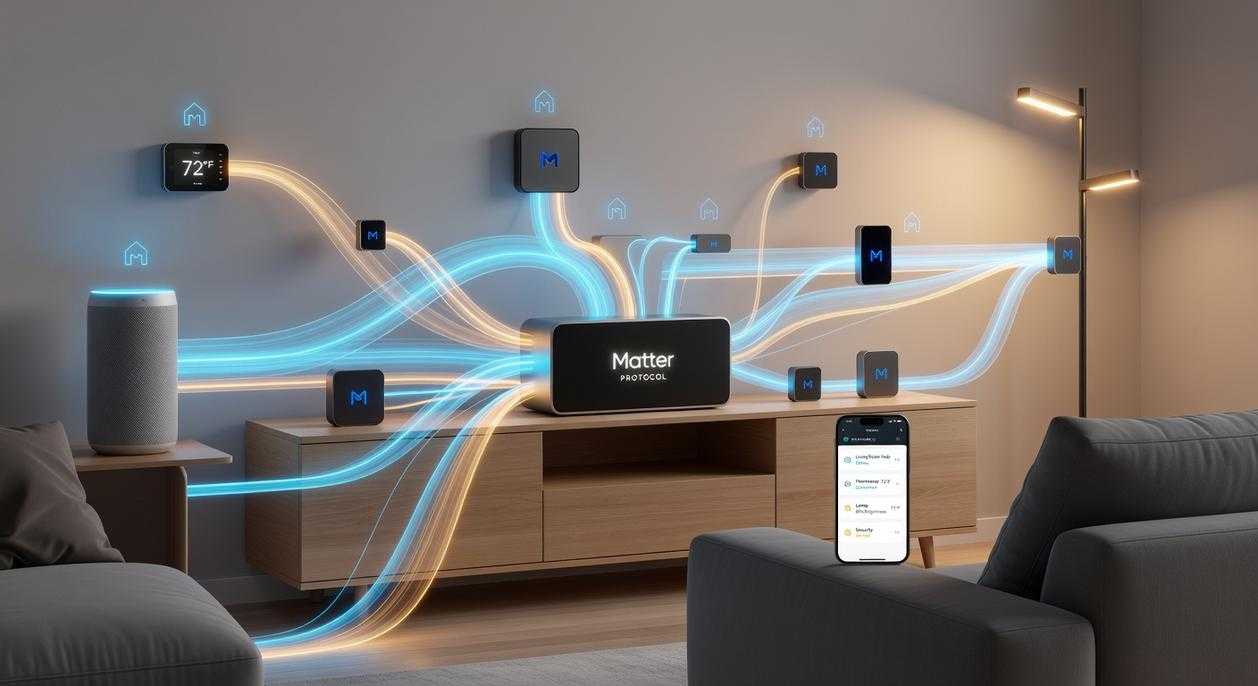
So, what does this actually change in your day-to-day life? Quite a lot.
True Interoperability
Interoperability means different devices and platforms working together seamlessly. In practical terms, you can buy a smart bulb, thermostat, or lock with the new standard’s logo and trust it will work with your preferred ecosystem. For example, imagine installing a Google Nest thermostat and controlling it through Apple Home without complicated workarounds. That’s not a tech fantasy anymore—it’s the promise of the matter smart home standard.
Some skeptics argue brands will still favor their own ecosystems. Fair point. However, certification requires cross-platform compatibility, and major players like Apple, Google, and Amazon are backing it (Connectivity Standards Alliance). That level of industry support is hard to ignore.
Simplified Setup
Next, setup gets dramatically easier. Instead of downloading multiple apps and juggling passwords, you simply plug in the device, scan a QR code, and approve it in your preferred app. Done.
Pro tip: Before adding a new device, update your phone and hub software to avoid minor pairing glitches (they happen).
Enhanced Security
Security isn’t optional—it’s built in. Devices must use strong encryption (scrambling data so outsiders can’t read it) and authenticated connections, meaning only verified devices can communicate. According to the CSA, this includes device attestation to prevent spoofing.
Future-Proofing Your Investment
Finally, buying compliant devices protects your wallet. As new products roll out, they’re designed to remain compatible. Instead of replacing everything every few years (no one wants that bill), your smart home evolves with you.
In short, fewer headaches, tighter security, and smarter spending.
Getting started with the new smart home era doesn’t have to be complicated. In fact, a few practical steps can save you time and frustration.
1. Look for the Matter Logo
First, check device packaging for the official badge. The matter smart home standard ensures products work across major platforms.
-
Add a Compatible Hub
Next, make sure you have a border router, such as a recent Apple TV, Google Nest Hub, or Amazon Echo, to bridge Thread devices to Wi-Fi. -
Check for Firmware Updates
Finally, visit manufacturer apps to see whether existing devices can be updated over-the-air.
Building a Truly Smart, Effortless Home
For years, smart homes felt anything but smart. Devices refused to talk, apps multiplied, and setup guides read like IKEA manuals without pictures (frustrating, to say the least). That fragmented era is ending.
The matter smart home standard unifies brands under one protocol—meaning:
- Interoperability across platforms
- Local control that keeps automations running even if Wi‑Fi drops
- Stronger built‑in security encryption
Some argue ecosystems were “good enough.” But good enough still meant lock‑in and cloud dependence. An effortless home works quietly in the background.
When you shop next, look for certified devices—and build with confidence.
Build a Smarter, Seamless Home Today
You came here to understand how today’s home trends, automation protocols, and device integrations fit together—and now you have a clearer path forward. From connected living basics to the power of the matter smart home standard, you’ve seen how the right foundation eliminates compatibility headaches and creates a truly unified system.
The real frustration with smart homes isn’t the technology—it’s when devices don’t talk to each other. Missed automations, unreliable connections, and confusing setups waste your time and money. Choosing the right standards and integration strategies solves that problem before it starts.
Now it’s time to take action. Audit your current devices, prioritize compatibility with the matter smart home standard, and upgrade strategically for long-term flexibility. If you want step-by-step guidance, expert-backed insights, and trusted recommendations to simplify your setup, explore our latest smart home resources and start building a system that finally works the way it should.
 There is a specific skill involved in explaining something clearly — one that is completely separate from actually knowing the subject. Arthuron Grantielos has both. They has spent years working with home trends update in a hands-on capacity, and an equal amount of time figuring out how to translate that experience into writing that people with different backgrounds can actually absorb and use.
Arthuron tends to approach complex subjects — Home Trends Update, Device Integration Tips, Home Automation Protocols being good examples — by starting with what the reader already knows, then building outward from there rather than dropping them in the deep end. It sounds like a small thing. In practice it makes a significant difference in whether someone finishes the article or abandons it halfway through. They is also good at knowing when to stop — a surprisingly underrated skill. Some writers bury useful information under so many caveats and qualifications that the point disappears. Arthuron knows where the point is and gets there without too many detours.
The practical effect of all this is that people who read Arthuron's work tend to come away actually capable of doing something with it. Not just vaguely informed — actually capable. For a writer working in home trends update, that is probably the best possible outcome, and it's the standard Arthuron holds they's own work to.
There is a specific skill involved in explaining something clearly — one that is completely separate from actually knowing the subject. Arthuron Grantielos has both. They has spent years working with home trends update in a hands-on capacity, and an equal amount of time figuring out how to translate that experience into writing that people with different backgrounds can actually absorb and use.
Arthuron tends to approach complex subjects — Home Trends Update, Device Integration Tips, Home Automation Protocols being good examples — by starting with what the reader already knows, then building outward from there rather than dropping them in the deep end. It sounds like a small thing. In practice it makes a significant difference in whether someone finishes the article or abandons it halfway through. They is also good at knowing when to stop — a surprisingly underrated skill. Some writers bury useful information under so many caveats and qualifications that the point disappears. Arthuron knows where the point is and gets there without too many detours.
The practical effect of all this is that people who read Arthuron's work tend to come away actually capable of doing something with it. Not just vaguely informed — actually capable. For a writer working in home trends update, that is probably the best possible outcome, and it's the standard Arthuron holds they's own work to.