
You’ve invested in a smart light, a smart lock, and a smart thermostat—only to discover they don’t play nicely together. The frustration isn’t the devices themselves; it’s the invisible “language” they use to communicate. Wi-Fi, Zigbee, Z-Wave, and now Matter each operate differently, and choosing home automation protocol is the decision that determines whether your setup feels seamless or stressful. This guide cuts through the jargon, breaking down the strengths and weaknesses of each standard so you can build a reliable, responsive system. Our insights come from extensive hands-on testing of real-world device integrations, focused on performance you can actually count on.
The 4 Pillars of a Strong Smart Home Network
Before comparing standards, it helps to understand what actually makes a smart home feel “smart.” In practice, every protocol balances four pillars differently.
Range refers to how far a signal travels without dropping. In a small apartment, Wi‑Fi may be enough. However, in a two‑story home with concrete walls, you may need mesh nodes or repeaters (yes, dead zones are still a thing in 2026).
Reliability & Speed determine whether your lights respond instantly or lag like a buffering video. Interference from crowded 2.4 GHz networks is a common culprit, especially in device-heavy households.
Power Consumption matters more than most competitors admit. A battery-powered door sensor using a high-drain protocol can die in weeks. Low-energy options like Zigbee or Thread are designed to sip power, not chug it.
Interoperability, meanwhile, is the long game. A seamless ecosystem prevents “brand islands” where devices refuse to cooperate. When choosing home automation protocol, balance these pillars strategically—not just conveniently.
The Classic Contenders: Wi-Fi vs. Zigbee vs. Z-Wave

When it comes to smart homes, the real debate isn’t which gadget to buy—it’s which wireless “language” your devices should speak. If you’ve ever felt confused by the technical jargon, you’re not alone. Let’s break this down clearly.
First, a quick definition: a protocol is simply a set of rules that devices use to communicate. Think of it like choosing between texting, calling, or emailing. Same message, different system.
Wi-Fi: The Powerhouse
Wi-Fi is the same network your phone and laptop use. It offers high bandwidth (meaning it can move large amounts of data quickly), which is why it’s perfect for streaming HD video.
Pros: It’s already in virtually every home, and it handles data-heavy tasks with ease. According to the Wi-Fi Alliance, billions of Wi-Fi devices ship annually, making it the most widely adopted wireless standard worldwide.
Cons: It consumes a lot of power. That’s bad news for battery-operated devices. It also operates on crowded frequency bands (2.4GHz and 5GHz), so every new device competes for bandwidth. (Ever notice your video buffering when everyone’s online?)
Best For: Smart cameras, video doorbells, and speakers—devices that are plugged in and constantly transmitting data.
Zigbee: The Speedy Mesh
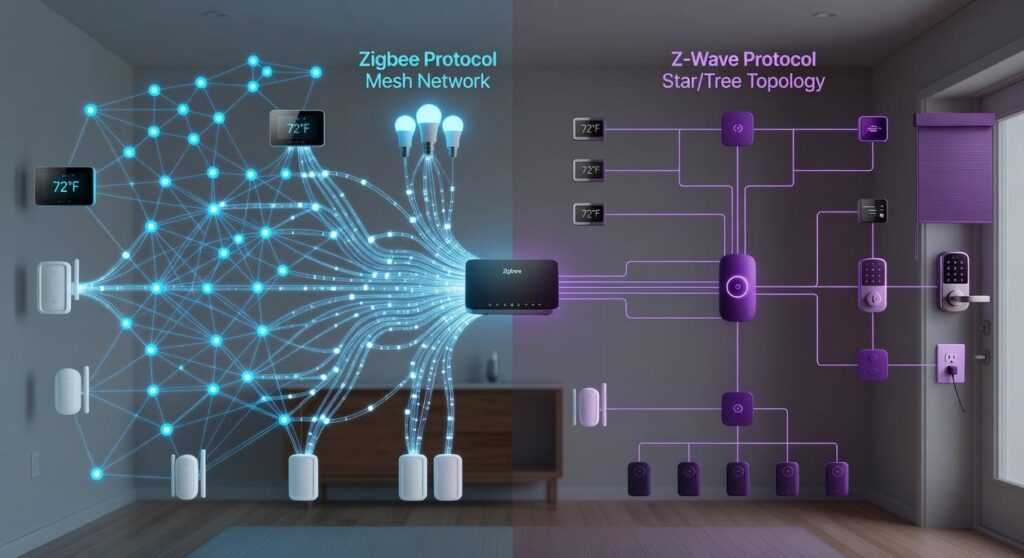
Zigbee uses a mesh network, meaning devices pass signals to one another instead of relying on a single router. The more devices you add, the stronger the network becomes.
Pros: Extremely low power consumption and very fast response times. That’s why your smart bulb turns on instantly.
Cons: It operates on the same 2.4GHz frequency as Wi-Fi, which can cause interference. It usually requires a dedicated hub.
If you want a deeper dive, this guide on understanding zigbee vs zwave key differences clarifies technical distinctions further.
Best For: Motion sensors, light switches, and bulbs where speed matters.
Z-Wave: The Reliability King
Z-Wave also uses a mesh network but operates on a lower-frequency band (around 908MHz in the U.S.), which reduces interference. The Z-Wave Alliance enforces strict certification standards, ensuring device compatibility.
Pros: Reliable, low power, and largely immune to Wi-Fi congestion.
Cons: Slightly slower data speeds and often higher device costs.
Best For: Smart locks and garage door openers—where reliability is non-negotiable.
Some argue Wi-Fi alone is enough. And yes, it’s simpler. But when choosing home automation protocol strategies, power efficiency and network stability often outweigh convenience. Pro tip: Mix protocols strategically rather than committing to just one. (Your future self will thank you.)
The Future is Unified: Understanding Matter & Thread
A year ago, I stood in my living room staring at three different smart home apps just to dim the lights and lock the door (not exactly the “Jetsons” future I imagined). That frustration is precisely why Matter and Thread matter.
What Is Matter?
Think of Matter as a universal translator. In technical terms, a standard is an agreed-upon set of rules devices follow so they can communicate. Matter is that rulebook. Instead of replacing Wi‑Fi or Thread, it sits on top of them, ensuring devices from different brands work together. When you see the “Works with Matter” logo, it signals interoperability—meaning your devices can cooperate across platforms like Apple Home or Google Home without awkward workarounds.
Some skeptics argue standards come and go (remember HD-DVD?). Fair point. However, Matter is backed by major industry players, which significantly increases its staying power (Connectivity Standards Alliance, 2023).
What Is Thread?
Now, Thread is a low-power mesh networking protocol—a method where devices relay signals to each other rather than relying on a single hub. Similar to Zigbee or Z-Wave, Thread was purpose-built for smart homes. Many Matter-certified devices use Thread underneath because it’s energy-efficient and reliable.
How They Work Together
For example:
- A Matter smart lock running on Thread
- A Matter smart display running on Wi‑Fi
- One unified control app
Because both support Matter, they sync seamlessly.
When choosing home automation protocol, prioritize the Matter logo. While no system is perfect, this approach dramatically reduces compatibility headaches and helps future-proof your setup. Pro tip: Look for devices that support both Matter and Thread for maximum flexibility.
Building Your Home’s Digital Blueprint
You set out to eliminate the frustration of mismatched devices and confusing setups—and now you have a clear plan to do exactly that. By choosing home automation protocol wisely, using Wi-Fi for high-bandwidth devices, relying on Zigbee or Z-Wave for stable sensor networks, and prioritizing Matter-certified products, you avoid the compatibility headaches that plague so many smart homes.
Don’t let poor planning turn your investment into a patchwork of disconnected gadgets. Take control of your ecosystem today—review your current devices, standardize your setup, and only buy Matter-ready tech moving forward. Thousands of smart homeowners are already building seamless systems. Start now and create a connected home that simply works.
 There is a specific skill involved in explaining something clearly — one that is completely separate from actually knowing the subject. Arthuron Grantielos has both. They has spent years working with home trends update in a hands-on capacity, and an equal amount of time figuring out how to translate that experience into writing that people with different backgrounds can actually absorb and use.
Arthuron tends to approach complex subjects — Home Trends Update, Device Integration Tips, Home Automation Protocols being good examples — by starting with what the reader already knows, then building outward from there rather than dropping them in the deep end. It sounds like a small thing. In practice it makes a significant difference in whether someone finishes the article or abandons it halfway through. They is also good at knowing when to stop — a surprisingly underrated skill. Some writers bury useful information under so many caveats and qualifications that the point disappears. Arthuron knows where the point is and gets there without too many detours.
The practical effect of all this is that people who read Arthuron's work tend to come away actually capable of doing something with it. Not just vaguely informed — actually capable. For a writer working in home trends update, that is probably the best possible outcome, and it's the standard Arthuron holds they's own work to.
There is a specific skill involved in explaining something clearly — one that is completely separate from actually knowing the subject. Arthuron Grantielos has both. They has spent years working with home trends update in a hands-on capacity, and an equal amount of time figuring out how to translate that experience into writing that people with different backgrounds can actually absorb and use.
Arthuron tends to approach complex subjects — Home Trends Update, Device Integration Tips, Home Automation Protocols being good examples — by starting with what the reader already knows, then building outward from there rather than dropping them in the deep end. It sounds like a small thing. In practice it makes a significant difference in whether someone finishes the article or abandons it halfway through. They is also good at knowing when to stop — a surprisingly underrated skill. Some writers bury useful information under so many caveats and qualifications that the point disappears. Arthuron knows where the point is and gets there without too many detours.
The practical effect of all this is that people who read Arthuron's work tend to come away actually capable of doing something with it. Not just vaguely informed — actually capable. For a writer working in home trends update, that is probably the best possible outcome, and it's the standard Arthuron holds they's own work to.